3.7 Strange Attractors

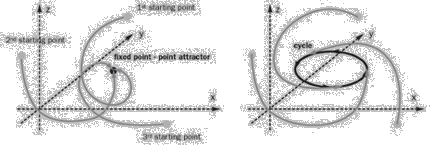
The long-term behavior of a system can be represented in the so-called n-dimensional “phase space”. There the specific time development is described through a trajectory, through which the history of the system is recorded. Attraction areas, to which these trajectories aim, are called attractors. Put into other words an attractor is a preferred position for the system to which it evolves no matter what the starting position is. Once such a position is reached it will then stay on the attractor in the absence of other factors.

The existence of an attractor[01] in general means for a scientific process that it possesses the characteristic either to run in a stable, periodical or quasi-periodical way. ‘Stable’ means that the system aims at a certain end condition, called point attractor or the fixed point of the system. On the other hand a process is ‘periodical’ if it repeats itself through a certain interval of time. Finally ‘quasi-periodical’ means that it lasts some time at the beginning until it turns into a periodical behavior - see picture 21.

picture 21: Strange attractor

In the chapter about non-linear, chaotic fractals we looked at what is happening to a certain point on the screen and depending on its behavior we colored it differently. Now we follow the iteration of the number instead. The number is used in a formula and the new number resulting from that is fixed on the screen, then this new number is again used in the same formula and fixed on the screen, and so on - this technique is also-called "hop-along".

One classical strange attractor is the “Lorenz attractor” that is used for the weather forecast. The weather forecast depends on many parameters such as season, vegetation, temperature or direction of the wind. Edward Lorenz tried to describe meteorological processes with the support of differential equations - e.g. the model describing the earth’s atmosphere has the form of


[http://stud4.tuwien.ac.at/~e9426503/soinfoges/mathematik.html (24.09.2001).]

The “Lorenz attractor” consists of one continuous infinitely long curve. Following a point on it will indicate that no curve is passed through twice, which means that the system behaves chaotic because nothing is regular. But nevertheless the function does not pass over certain borders in its long-term behavior. Zooming into the "Lorenz attractor" the line is split up and we will always find new structures. So it is not possible to locate exactly where the system is at a certain moment. From that follows that the weather can only be forecast for a short period.[Voß Herbert, Chaos und Fraktale - selbst programmieren (1994), Franzis-Verlag GmbH Österreich, ISBN 3-7723-7003-9, p.43.]

Another category of attractors is called strange attractors, whose name arises from their strange characteristics. They consist of an infinite sequence and offer an unpredictable chaotic behavior, but nevertheless in the phase space they occupy a sub-room of lower dimension. Looking at neighboring trajectories their expansions follow completely different directions. From that follows that though the system evolves to and remains on the attractor, it is not possible to give a long-term behavior - see picture 21. This category is often applied to represent chaotic systems[02] .

Footnotes

[01] The word “attractor” originates from the Latin “attrahere”. Voß Herbert, Chaos und Fraktale - selbst programmieren (1994), Franzis-Verlag GmbH Österreich, ISBN 3-7723-7003-9, p.26.
[02] In the geometrical expression a strange attractor is a fractal.

AlgoPlana 2026

Proceedings of the ALGOPLANA Conference 2026

The students‘ conference “Algorithms in Planning Practice 2026” is the result of a seminar held at the Research Unit Digital Architecture and Planning at the TU Wien in the summer semester 2026. ...

Urban Transformation Between Built and NaturalSystems by Means of an Adapted Wave FunctionCollapse Approach

Journal Paper In JoDLA –  Journal of Digital Landscape Architecture (e-ISSN 2511-624X)

In practice, urban transformation is often carried out at the outskirts or in between existing areas of a city. In that context, important questions are: How can one imagine a transition between different urban structures? ...

Healthcare and Wellbeing

Presentation: at the School of Environment and Society, Institute of Science Tokyo, Japan

This presentation explores process-driven approaches to healthcare design through early-stage functional planning and agent-based simulation. ...

Urban Data

Presentation: at the School of Environment and Society, Institute of Science Tokyo, Japan

This presentation explores how municipal data provided by the City of Vienna can be used to support urban analysis, planning, and decision-making. ...

eCAADe 2025:
Artificially Interactive Individualized Genetic Algorithms (AIIGA) for Gestalt Analysis

Evolutionary algorithms enhanced with sAI in architectural design
Talk and Proceeding: eCAADe 2025 – Confluence (Ankara, Turkey | conference)

This research is concerned with the automation of the user interventional aspect within interactive genetic algorithms (IGA) as already explored in previous publications by the authors considering their use for Gestalt analyses and generative design optimization. ...

Interview with Wolfgang E. Lorenz

in: DAP / Re:Search_2020.2025
S. 244 - 257, Research Department for Digital Architecture and Planning, TU Wien (Publisher)

Interview with Wolfgang E. Lorenz on research, teaching, and practice, especially over the last 5 years