III Different Fractals

Every natural thing around us is a fractal structure in principle, because smooth lines and planes only exist in the ideal world of mathematics. Beside that theoretically any system, which can be visualized or analyzed geometrically, can be a fractal.

This chapter gives an introduction to some different kinds of fractals like the so-called "true" mathematical fractals, to which the Cantor set belongs, and the "chaotic" fractals, with the Mandelbrot set being an example. Beside that some other methods of creating fractals such as the iteration function systems, the DLA model, the L-system and the Midpoint displacement method will be introduced. The form of strange attractors as a connection to deterministic chaos also offers fractal characteristics and will be described at the end of this chapter. The one or other type of fractal may help in creativity, analysis, comparison, construction, organization and other questions arising in architecture.
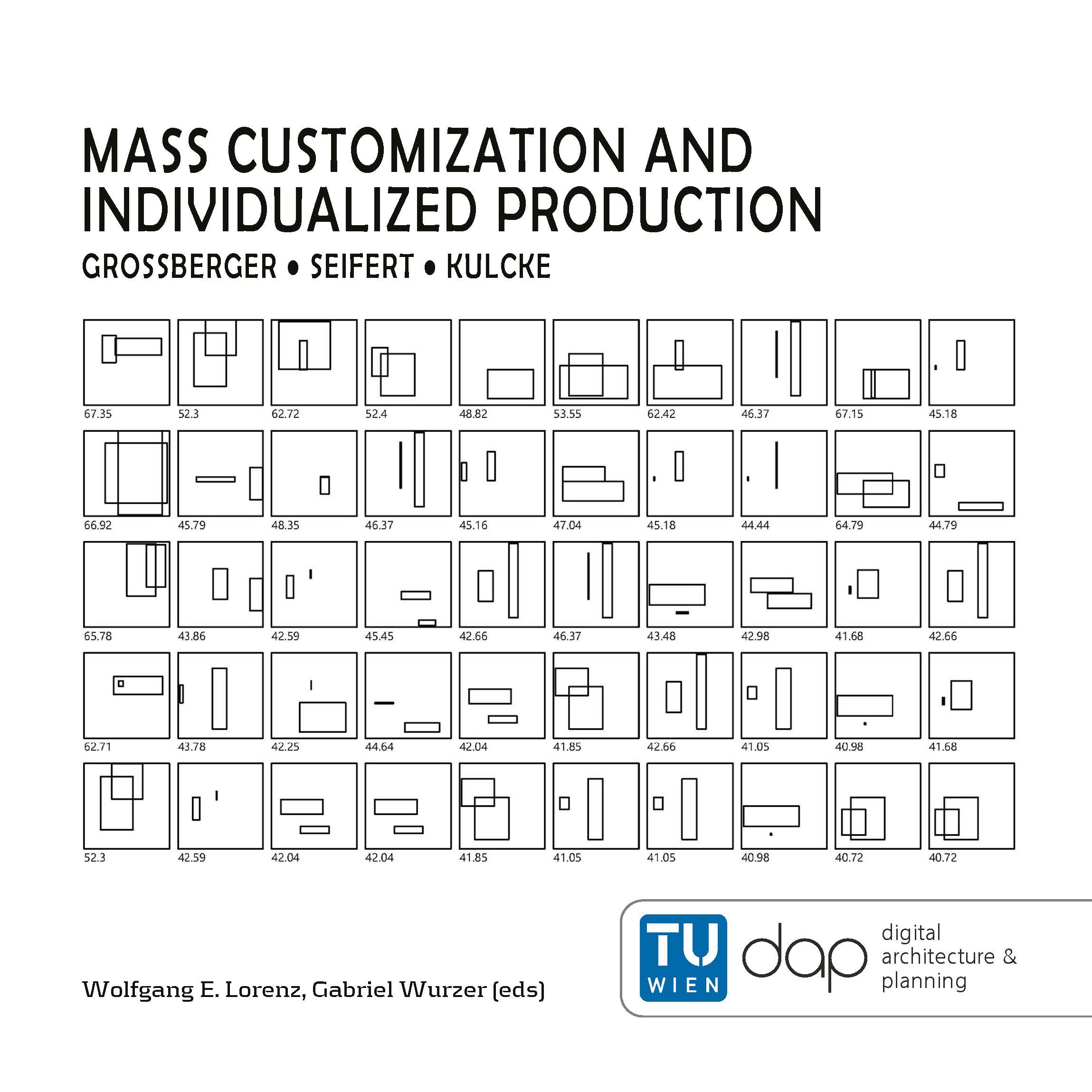
Mass Customization and Individualized Production

A Companion Textbook

The concept of mass customization has already found its way into architecture. But where does the term come from, what are the basic requirements, and what are the challenges, especially in architecture? ...

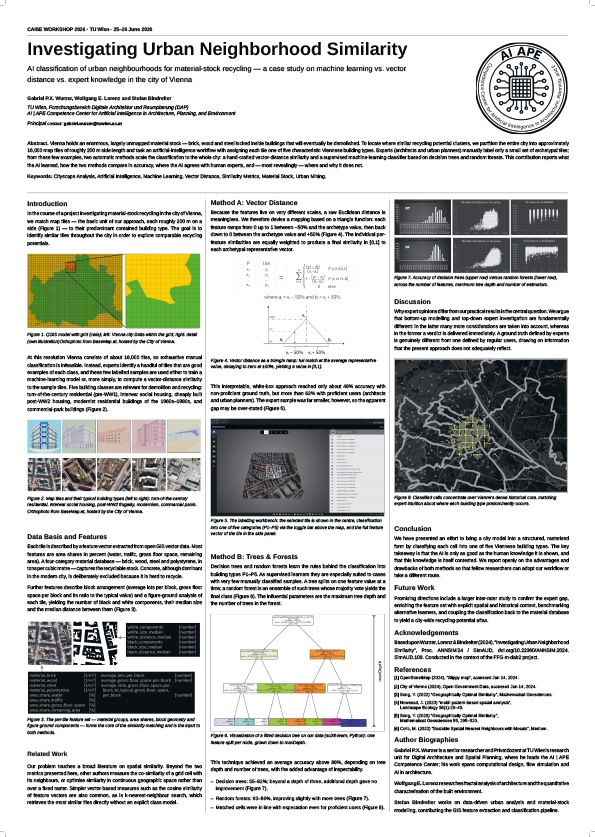
Investigating Urban Neighborhood Similarity

AI classification of urban neighbourhoods for material-stock recycling — a case study on machine learning vs. vector distance vs. expert knowledge in the city of Vienna

Vienna holds an enormous, largely unmapped material stock — brick, wood and steel locked inside buildings that will eventually be demolished. To locate where similar recycling potential clusters, we partition the entire city into approximately 16,000 map ...

AlgoPlana 2026

Proceedings of the ALGOPLANA Conference 2026

The students‘ conference “Algorithms in Planning Practice 2026” is the result of a seminar held at the Research Unit Digital Architecture and Planning at the TU Wien in the summer semester 2026. ...

Urban Transformation Between Built and NaturalSystems by Means of an Adapted Wave FunctionCollapse Approach

Journal Paper In JoDLA –  Journal of Digital Landscape Architecture (e-ISSN 2511-624X)

In practice, urban transformation is often carried out at the outskirts or in between existing areas of a city. In that context, important questions are: How can one imagine a transition between different urban structures? ...

Healthcare and Wellbeing

Presentation: at the School of Environment and Society, Institute of Science Tokyo, Japan

This presentation explores process-driven approaches to healthcare design through early-stage functional planning and agent-based simulation. ...

Urban Data

Presentation: at the School of Environment and Society, Institute of Science Tokyo, Japan

This presentation explores how municipal data provided by the City of Vienna can be used to support urban analysis, planning, and decision-making. ...